
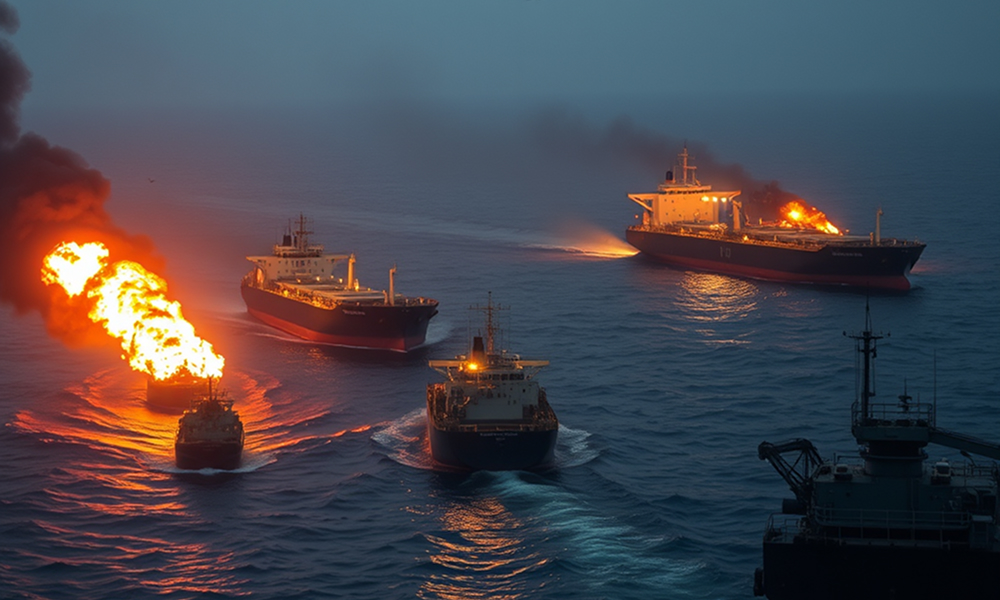
Iran is considering closing the key oil shipping route Strait of Hormuz after the US bombed three of its nuclear facilities, Iranian media reported today.
The Strait of Hormuz is one of the world’s most critical chokepoints, through which a fifth of global oil and gas supply flows.

It connects the Persian Gulf to the Arabian Sea and the Indian Ocean. The narrow channel, approximately 33 km wide at the narrowest point, separates Iran (north) from the Arabian Peninsula (south).
The bulk of oil exports from regional powerhouses – Saudi Arabia, Iraq, the UAE, Qatar, Iran, and Kuwait – must transit this narrow waterway. In the past, it was the West – chiefly the US and Europe – that stood most exposed to disruption in Persian Gulf energy flows, but today it is China and Asia that would bear the brunt of any closure.
For India, the Strait of Hormuz is important as about 2 million barrels per day (bpd) of crude oil out of its total import of 5.5 million bpd transits through the narrow waterway.
Having diversified its sources of imports, India, however, is unlikely to lose sleep even if the Strait of Hormuz is shut down as alternative sources from Russia to the US and Brazil are readily available to fill any void, industry officials and analysts said.
Russian oil is logistically detached from the Strait of Hormuz, flowing via the Suez Canal, Cape of Good Hope, or the Pacific Ocean.




 World Info Hub
Leave a comment